Supreme Court Clarifies: Traffic Challans Will NOT Be Linked to Electricity Bills (Oct 2026)
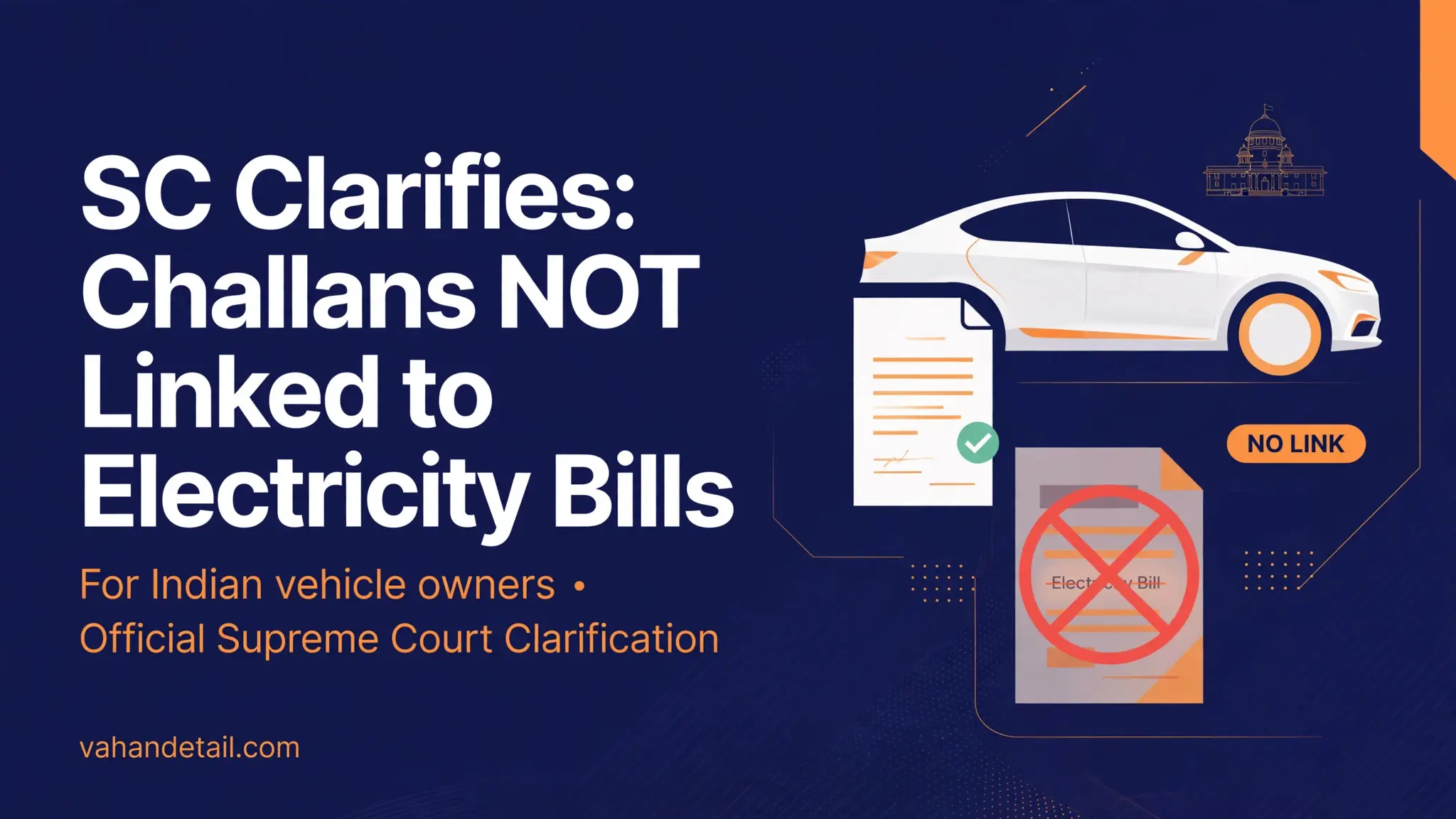
No, the Supreme Court has NOT ordered that unpaid traffic challans be linked to electricity bills. Talk of a supreme court challan electricity bill link order has gone viral on WhatsApp and social media, but the claim is misleading. In its order of September 28, 2026, the court only suggested that states examine the idea of such a link, and that suggestion is not part of the court’s actual directions.
The Viral Rumor: What Is Being Claimed
Over the past few days, messages have been circulating claiming that the Supreme Court has ordered traffic police to block or disconnect the electricity connections of vehicle owners who have unpaid e-challans. Some versions even claim that discoms (electricity distribution companies) will soon receive lists of defaulters and stop issuing new connections to them.
This rumor grew out of genuine news. In the long-running road safety case S. Rajaseekaran vs Union of India, which the Supreme Court has been monitoring since 2012, a bench of Justices JB Pardiwala and KV Viswanathan did pass a strong order on September 28, 2026 (uploaded on October 1) to recover a staggering mountain of unpaid challans. Figures placed before the court showed total e-challan dues of Rs 49,194.05 crore, of which only Rs 26,175.05 crore has been recovered. Roughly Rs 23,019 crore is still outstanding. Against that backdrop, the idea of linking challans to electricity bills did come up, but only in courtroom discussion, not in the order.
What the Supreme Court Order Actually Says
This is a follow-up to our detailed breakdown of the main order. If you missed it, read our full explainer: Supreme Court: Unpaid Challans Can Block Your RC, PUC and Licence. For the record, here are the real directions the court issued. These are binding, unlike the electricity bill suggestion.
Random checks and impounding. Traffic authorities are to carry out random vehicle checks and impound vehicles that have unpaid challans against them.
Frozen online services. RC renewal, duplicate RC issuance and address updates on the RC will be frozen for owners with outstanding challan dues.
No fitness certificates. Fitness certificates for vehicles with unpaid challans will be denied.
Blacklisted on Parivahan. Such vehicles will be blacklisted on the Parivahan portal, which blocks their sale or ownership transfer.
No PUC certificate. Pollution Under Control certificates will not be issued until dues are cleared, which in turn affects insurance and registration validity.
Licence action for repeat offenders. For habitual defaulters, renewal of driving licences will be suspended and steps will be taken to suspend the existing licence itself.
Suggested vs Ordered: Why the Supreme Court Challan Electricity Bill Link Has No Legal Force
This is the heart of the matter, and it is worth understanding clearly because it protects you from misinformation.
During hearings, courts often float ideas to test whether the government or the parties find them workable. In these proceedings, the electricity bill linkage was exactly that, an idea floated for discussion. The court suggested that states could examine whether unpaid challans might one day be linked to electricity bills. The written order contains no such direction. No state has been ordered to implement it, no timeline has been fixed, and no discom has been given any instruction by the court.
In legal terms, there is a big difference between an observation or suggestion made during proceedings and a direction recorded in an order. Only the directions bind the authorities. The electricity bill link sits firmly in the first category.
Could a supreme court challan electricity bill link happen in the future? Possibly. States are free to examine the idea, and if a state government someday notifies such a policy, it would have to survive its own legal and practical challenges. For now, though, it is not law, and no vehicle owner needs to fear a power cut because of an old challan.
What Vehicle Owners Should Do Right Now
The rumor may be false, but the order itself is very real, and ignoring your pending challans is now genuinely risky. A blacklisted vehicle or a suspended licence is a far more immediate problem than a hypothetical electricity bill link. Here is what to do today.
Check whether you have pending challans
Go to the official portal: echallan.parivahan.gov.in. On the homepage you will see three search options.
- By challan number. If you have the challan slip or the number from a traffic stop, enter it along with the captcha and click Get Detail.
- By vehicle number. Enter your registration number (for example, DL1AB1234) with the captcha to see every challan issued against the vehicle, whether you were driving or not.
- By driving licence number. Enter your DL number to check challans tagged to your licence.
The results page shows each challan with the offence, date, place, amount and its status (pending, paid or disputed). Do this for every vehicle your family owns, because RC-linked services are now blocked for the registered owner’s dues.
Pay the dues online
On the challan details page, select the challans you want to pay and proceed to payment. The portal accepts netbanking, UPI, and debit and credit cards through its payment gateway. After a successful payment, download and save the receipt. Keep a screenshot as well, because portals occasionally take a day or two to reflect the paid status, and a receipt settles any argument at a roadside check.
Dispute wrong challans properly
If a challan is wrongly issued, do not simply ignore it. Use the grievance option on the echallan portal to raise a complaint with the details, or approach the concerned traffic court. Ignoring a wrong challan now carries the same consequences as ignoring a genuine one.
Clear repeat-offender risk
If you or a family member has multiple unpaid challans, prioritise clearing them. The court’s order specifically singles out repeat offenders for licence suspension action. Settling dues before enforcement drives begin is far cheaper and less stressful than getting your vehicle impounded or your licence suspended.
For a general step-by-step walkthrough of checking and paying traffic challans on Parivahan, see our complete e-challan guide. And if you want the full picture of what the court ordered beyond the electricity bill rumor, our companion piece covers every direction in detail: Supreme Court: Unpaid Challans Can Block Your RC, PUC and Licence.
Did the Supreme Court order that traffic challans be linked to electricity bills?
No. The idea was only suggested during proceedings as something states could examine. It does not appear in the court’s written order and is not a binding direction.
Can my electricity connection be disconnected for an unpaid challan?
Not on the basis of this Supreme Court order. No direction has been issued to discoms or state electricity departments about traffic challan defaulters.
What did the court actually order about unpaid challans?
Random vehicle checks with impounding, freezing of RC-related online services, denial of fitness certificates, blacklisting vehicles on Parivahan, withholding PUC certificates, and licence suspension steps for repeat offenders.
How do I check my pending challans on the Parivahan portal?
Visit echallan.parivahan.gov.in and search by challan number, vehicle number, or driving licence number, complete the captcha, and review the list of pending challans with amounts.
How can I pay a traffic challan online?
Select the challans on the portal, pay through the gateway using netbanking, UPI, or a debit or credit card, and download the payment receipt for your records.
Will the electricity bill link ever become real?
The court only suggested that states examine the idea. If any state government someday notifies such a policy, it would be announced officially and face its own legal scrutiny. As of now, it is not in force anywhere.