
Green Tax on Old Vehicles: Rates, Who Pays and How to Pay (2026)
Green tax is an additional levy charged on older vehicles at the time of fitness or registration renewal, and it typically works out to 10 to 25 percent of the road tax you would otherwise pay. It applies to personal vehicles older than 15 years at registration renewal and to transport vehicles at fitness renewal, with rates varying by state. If you own an ageing car or commercial vehicle, green tax is one of the real costs of keeping it on the road, alongside the fitness test itself.
What Green Tax Is and Why It Exists
Green tax, sometimes called the green cess, is a pollution-linked charge introduced through central motor-vehicle rules. The logic is simple: older vehicles pollute more per kilometre, so their owners pay an extra levy that both discourages keeping highly polluting vehicles running and funds pollution-control measures. It is collected by the state transport department, usually bundled with the fitness certificate renewal or registration renewal process, which means most owners first encounter it when their 15-year renewal comes due.
Who Has to Pay Green Tax
The liability depends on vehicle type and age:
- Personal (non-transport) vehicles: green tax becomes payable at the time of renewal of registration after 15 years from the date of first registration.
- Transport (commercial) vehicles: green tax is levied at the time of renewal of the fitness certificate, with older commercial vehicles attracting it at each renewal cycle.
- Strongly polluting vehicles: vehicles identified as heavily polluting can attract a higher levy, guided at up to 50 percent of the road tax, at the authorities’ assessment.
Exemptions exist for cleaner technologies. Electric vehicles and vehicles running on cleaner alternative fuels such as CNG, ethanol, and LPG are generally exempt from green tax. Exact exemptions and rates are notified state by state, so a CNG car in one state and the same car in another can face slightly different treatment. Delhi and some other states have their own variations, so always confirm with your state transport department.
Green Tax Rates: What You Actually Pay
The central guidelines frame green tax as a percentage of the road tax applicable to the vehicle:
| Vehicle category | When it applies | Indicative rate |
|---|---|---|
| Personal vehicle older than 15 years | At registration renewal | 10 to 25 percent of road tax |
| Transport vehicle at fitness renewal | At each fitness renewal for older vehicles | 10 to 25 percent of road tax |
| Strongly polluting vehicle | At renewal, on assessment | Up to 50 percent of road tax |
| Electric / CNG / ethanol / LPG vehicles | Not applicable | Generally exempt |
These are guiding bands, not a single national tariff. Your state notification fixes the exact percentage within the band, and some states add their own slabs by vehicle age or fuel type. Treat any figure a

How to Pay Green Tax Online on Parivahan
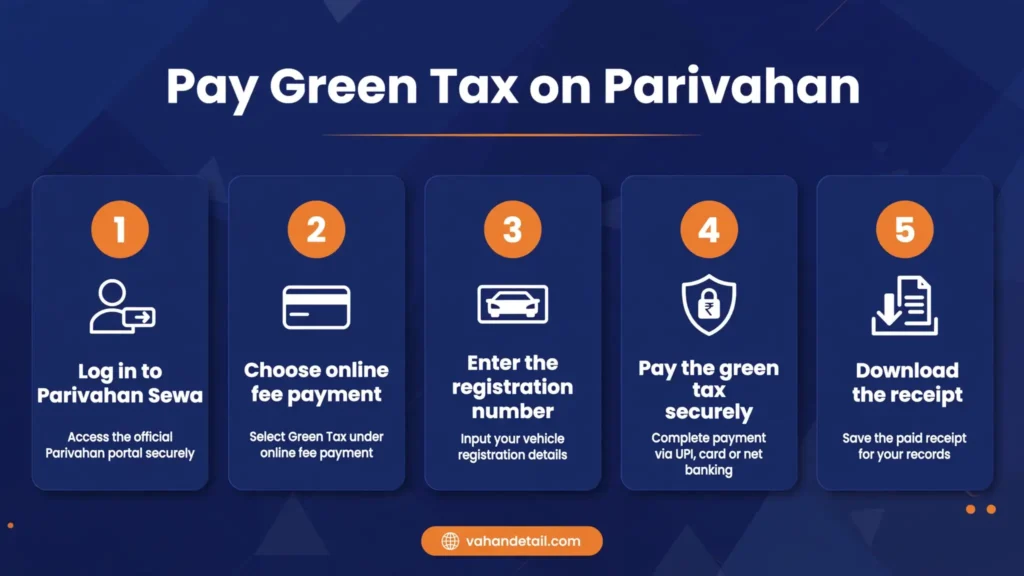
Green tax is paid through the same tax-payment flow as road tax on the Parivahan Sewa portal:
- Go to the Parivahan Sewa portal and select your state.
- Open the online services section and choose the tax payment service (listed as payment of motor vehicle tax).
- Enter your vehicle registration number. The portal pulls up your vehicle details from the Vahan portal records.
- Select the tax type. Green tax appears as a separate line item alongside road tax when your vehicle is due for it.
- Verify the calculated amount, which the system derives from your state’s notified rates.
- Pay using UPI, net banking, or a debit or credit card.
- Download and save the payment receipt. You will need it at the RTO during the fitness or renewal inspection.
Visit the Parivahan Sewa portal
Select your state on the portal to begin the tax payment flow.
Open the tax payment service
Choose the payment of motor vehicle tax service from the online services section.
Enter your registration number
The portal pulls up your vehicle details from the Vahan portal records.
Select green tax
Choose green tax as the tax type; it appears as a separate line item when due.
Verify the amount
Check the system-calculated amount derived from your state’s notified rates.
Pay the tax
Pay using UPI, net banking, or a debit or credit card.
Download the receipt
Save the payment receipt for your RTO visit during the fitness or renewal inspection.
Pay before your RTO visit. Inspectors check the receipt as part of the renewal paperwork, and arriving without it means a wasted trip. If the portal does not show a green tax line for your vehicle, either your
Green Tax vs Road Tax: The Difference
Road tax is the one-time or periodic tax paid for the right to use the vehicle on public roads, calculated on the vehicle’s price or weight depending on the state. Green tax is an additional, age-triggered levy layered on top, meant specifically to price in the extra pollution of older vehicles. You can pay one without the other being due, and at renewal time after 15 years you will typically see both on the same challan. Our road tax check guide explains how to verify your road tax dues separately.
Should You Pay Green Tax or Scrap the Vehicle?
This is the practical question for every 15-plus-year vehicle owner. Add up three numbers: the green tax due, the fitness test fee plus likely repair costs to pass it, and the insurance renewal. Then compare that total against the scrappage route: the scrap payout plus road-tax rebate and registration-fee waiver on a new vehicle under the vehicle scrappage policy. If keeping the old vehicle road-legal for another five years costs more than a third of a replacement’s down payment, scrapping usually wins. Also check your fitness certificate status first, since a vehicle that cannot pass fitness makes the decision for you.
Frequently Asked Questions
What is green tax on old vehicles?
Green tax is an extra levy on older, more polluting vehicles, collected at fitness or registration renewal. It generally ranges from 10 to 25 percent of the applicable road tax, with cleaner-fuel vehicles usually exempt.
At what vehicle age does green tax apply?
For personal vehicles, it applies at registration renewal after 15 years. For transport vehicles, it applies at fitness certificate renewal for older vehicles. Strongly polluting vehicles can attract up to 50 percent of road tax.
Which vehicles are exempt from green tax?
Electric vehicles and vehicles running on alternative cleaner fuels such as CNG, ethanol, and LPG are generally exempt. Exact exemptions are notified by each state.
How is green tax calculated?
It is calculated as a percentage of the road tax for your vehicle, within the 10 to 25 percent band (up to 50 percent for strongly polluting vehicles). Your state’s transport department notification fixes the precise rate.
Can I pay green tax online?
Yes, through the tax payment service on the Parivahan Sewa portal. Enter your registration number, select the tax type, verify the system-calculated amount, pay by UPI, net banking, or card, and keep the receipt for your RTO visit.
What happens if I do not pay green tax?
The renewal, whether fitness certificate or registration, will not be completed without it. Driving with an expired fitness certificate or registration invites challans and, in enforcement drives, seizure of the vehicle.