Delhi Traffic Challan New Rule (2026): 50% Deposit Before Court Appeal
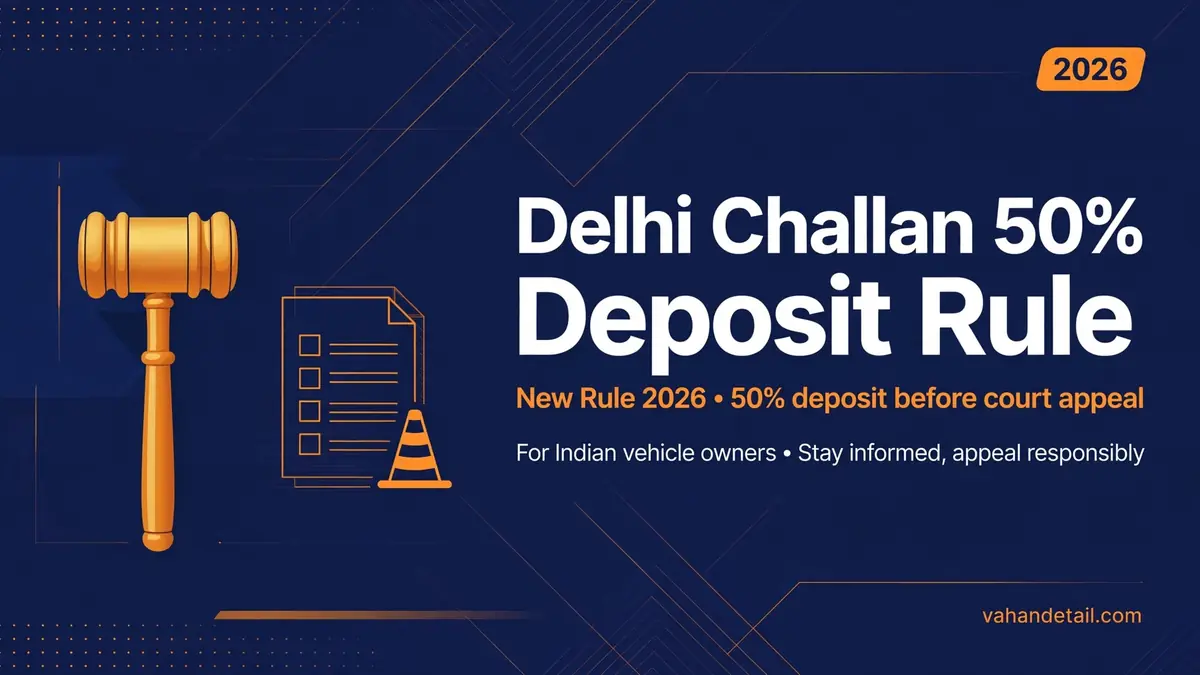
Here is the honest position on the Delhi challan 50% deposit court appeal rule: the system was announced by Delhi CM Rekha Gupta in May 2026 and formally notified on 14 September 2026 as an amendment to Rule 167 of the Central Motor Vehicles Rules, 1989, but its implementation has been put on hold after objections from the Coordination Committee of Delhi District Court Bar Associations in late September 2026. The Transport Minister has said the notification is under review. It is not currently in force, and this article explains what the proposed system says, where it stands today, and what Delhi drivers should actually do right now.
What the Proposed System Says
The proposed rule redesigns how a Delhi traffic challan can be disputed. Instead of the current route where a disputed challan simply moves toward court, the new system adds structured online steps with strict timelines. Here is the process as laid out in the notified proposal:
- Challan is issued. The e-challan reaches the registered mobile number within 3 days of the violation, and physical notices are sent within 15 days.
- 45-day window to pay or challenge. From the date the challan is issued, the violator gets 45 days to either pay the fine or file a challenge online before a designated grievance redressal officer, along with documentary evidence.
- Grievance officer decides. The officer must examine the challenge and upload the decision on the portal within 30 days.
- If the grievance is rejected: pay the full amount within 30 days, or approach the court after depositing 50% of the challan amount. So on a Rs 2,000 challan, you deposit Rs 1,000 to unlock the court route.
- If no action within 45 days: the challan is treated as accepted by the violator, and it must be paid within the following 30 days.
- Court outcome decides the money. If the court cancels the challan, the 50% deposit is refunded. If the court upholds it, the remaining 50% must be paid.
The stated idea behind the deposit is to reduce frivolous challenges while still giving genuine wrong-challan cases a fair hearing.
Where Things Stand: On Hold and Under Review
After the 14 September 2026 notification, the Coordination Committee of Delhi District Court Bar Associations raised objections, and by late September 2026 the implementation was put on hold. The Transport Minister has said the notification is under review. As of October 2026, the old system continues to apply: disputed challans still move through the existing court process without any 50% deposit requirement. This is an important distinction because early news coverage of the announcement led many drivers to believe the deposit rule was already active. It is not. No court will ask you for a 50% deposit to hear your challan dispute today.
Why the Government Proposed This Change
The background is a mountain of pending challans. E-challans can now be generated by traffic cameras and speed sensors without a policeman stopping you, so volumes are far higher than before, and many drivers never see the SMS or never act on it. The proposed system tries to fix three problems at once: give people a quick online first stop (the grievance officer) instead of forcing everyone into court queues, put real deadlines on every step so disputes do not drift for years, and attach a consequence to unpaid challans on the Vahan portal. That last point is already real law in a different form: under Supreme Court directions, vehicles with unpaid challans are flagged as “not to be transacted” on the Vahan portal, which blocks RC renewals, PUC-related services, tax payments and licence services until the dues are cleared.
Check pending challans on the portal
Check your pending Delhi traffic challans online and clear any dues before they accumulate.
Challenge a wrong challan online with documentary evidence
Dispute a wrong e-challan through the existing Parivahan e-challan dispute process with photos, timestamps, or other proof.
Under the proposed system: raise it before the grievance officer within 45 days
File your challenge online before the designated grievance redressal officer within 45 days of the challan being issued.
If rejected, deposit 50% before court appeal
If the grievance is rejected, deposit 50% of the challan amount to unlock the court route; the deposit is refunded if the court cancels the challan.
What Delhi Drivers Should Do Today
Ignore the proposed rule and follow the current one. Here is the practical checklist:
- Check your pending challans now. Use this guide to check Delhi traffic challan status online and clear any pending ones. Old unpaid challans are the single biggest source of trouble at RC renewal or resale time.
- If you received a wrong challan, dispute it through the existing Parivahan e-challan dispute process. You do not need to deposit anything to file a complaint today. Attach documentary evidence such as photos, timestamps, or proof that the vehicle was elsewhere.
- Update your registered mobile number. Since e-challans reach you within 3 days by SMS, an outdated mobile number on your RC is how most “surprise challans” are born. Keep it current on the Vahan portal.
- Do not ignore a challan. The proposed system has a “treated as accepted” rule, but even under the current system, an ignored challan does not disappear. It accumulates and eventually blocks your RC, tax and DL transactions on the Vahan portal.
- Know the serious-offender threshold. Under the proposed system, 5 or more violations in a year can flag a driver as a ‘serious offender’, with possible driving licence suspension or cancellation. Whether or not this particular provision survives the review, repeated violations are already treated harshly under the Motor Vehicles Act, so treat every challan as a warning.
Payment Modes Under the Proposed System
The proposal refers to payment through electronic modes on the official portal rather than cash at counters. If and when the system is revived, expect the payment and deposit flow to sit inside the Delhi traffic police or Parivahan e-challan portal interface. Do not pay anyone claiming to collect challans offline or through unofficial links. The only legitimate sources are the official portals, which you can find via the links above and at parivahan.gov.in.
Will the Rule Come Back?
That is the open question. The notification exists, but the Bar Association objections and the Transport Minister’s “under review” statement mean the final shape could change. Possible outcomes: the rule returns as-is, it returns in a modified form (for example, a lower deposit percentage or a different grievance structure), or it is scrapped. If you want to stay ahead, check your challan status every month or two and keep an eye on official announcements from the Delhi Transport Department. We will update this article when there is a confirmed decision.
Is the 50% deposit rule in force right now?
No. It was notified on 14 September 2026 but implementation was put on hold later that month after objections from the Delhi District Court Bar Associations. The Transport Minister has said it is under review. The old challan-dispute process continues to apply.
Do I have to pay 50% immediately on getting a challan?
No. There is no such requirement today. The 50% deposit was only a step inside the proposed system, and that system is on hold. You pay or challenge your challan under the existing rules.
How do I challenge a wrong challan today?
Use the existing Parivahan e-challan dispute process, which is free and online. File your complaint with documentary evidence and track its status on the portal.
What happens if I ignore a challan?
It does not go away. Unpaid challans accumulate, and your vehicle gets flagged “not to be transacted” on the Vahan portal, blocking RC renewals, tax payments and licence services until the dues are cleared.
Will I get my deposit back if the court rules in my favour?
Under the proposed (currently on-hold) system, yes: if the court cancels the challan, the 50% deposit is refunded; if the court upholds it, the remaining 50% must be paid. Since the rule is not in force, this situation does not arise today.
I received an e-challan for a violation I did not commit. What should I do first?
Check the challan details against the photo or evidence attached on the portal, gather your own proof (dashcam footage, location history, parking receipts), and file a dispute through the official portal right away. Do not let it sit.