Revised GRAP Rules Delhi-NCR (Oct 2026): Rs 20,000 Fine for BS-III Petrol, BS-IV Diesel Cars
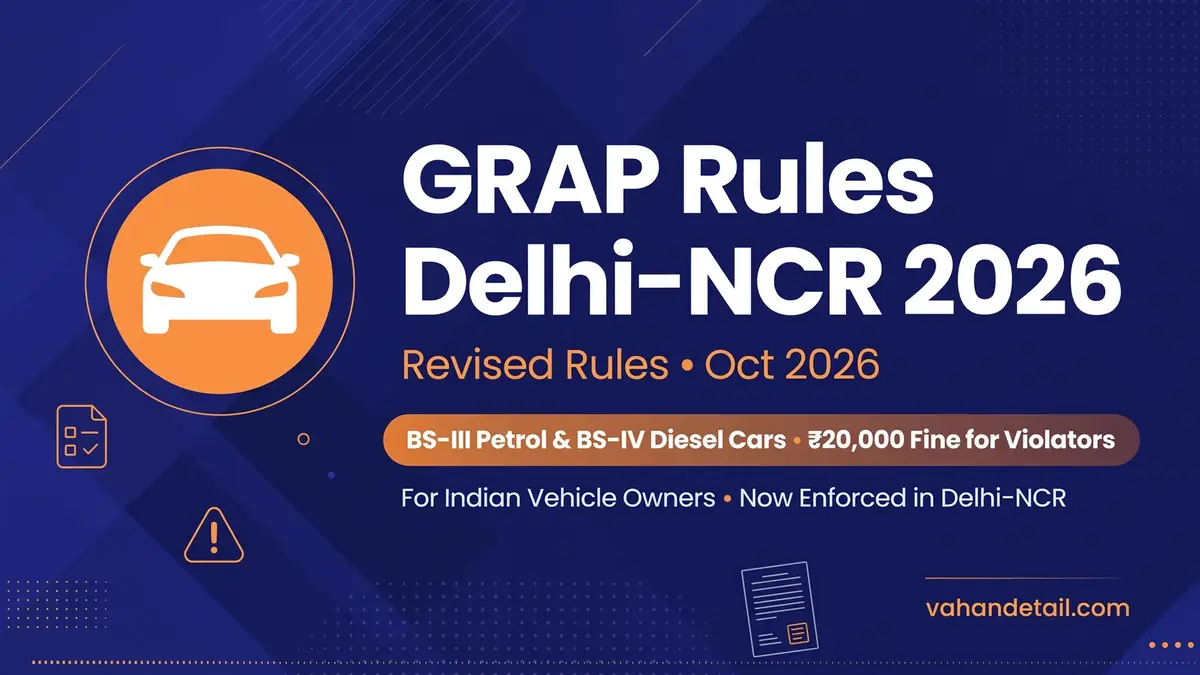
If you drive in Delhi-NCR this winter, the GRAP rules Delhi NCR 2026 bring tighter curbs on older cars than before. The Commission for Air Quality Management (CAQM) has approved a revised Graded Response Action Plan with 48 actions across four stages, and once Stage III is active, BS-III petrol and BS-IV diesel four-wheelers face plying restrictions, with violators liable for a Rs 20,000 fine. Here is exactly what motorists need to know.
What is GRAP and Why It Was Revised
The Graded Response Action Plan (GRAP) is Delhi-NCR’s emergency playbook for air pollution. Instead of one fixed set of rules, GRAP has stages that get activated as the air quality index (AQI) worsens. Stage I triggers in the “poor” range, Stage II in “very poor”, Stage III in “severe” (AQI 401-450), and Stage IV beyond AQI 450. CAQM revised the schedule in October 2026 to close gaps seen in earlier winters. Several measures were moved to earlier stages, coverage was extended to one more NCR district, and exemptions that were being misused were removed. For vehicle owners, the headline change is in Stage III: a clearer, harder restriction on older private cars, backed by a steep fine.
GRAP Rules Delhi NCR 2026: The 4 Stages at a Glance
| Stage | AQI Trigger Range | Actions | What Changes for Vehicles |
|---|---|---|---|
| Stage I | Poor (201-300) | 25 actions | Diesel generator set curbs; BS-IV-and-below inter-city/inter-state buses restricted |
| Stage II | Very Poor (301-400) | 8 actions | Additional restrictions on vehicular movement and construction |
| Stage III | Severe (401-450) | 10 actions | BS-III petrol, BS-IV diesel LMVs restricted; Rs 20,000 fine |
| Stage IV | Severe-plus (above 450) | 5 actions | Stricter curbs including heavy goods vehicles |
The revised schedule has 48 actions in total: 25 in Stage I, 8 in Stage II, 10 in Stage III, and 5 in Stage IV.
Which Vehicles Are Affected Under Stage III
This is the part every car owner should read carefully. When GRAP Stage III is invoked:
- Restricted: BS-III petrol and BS-IV diesel four-wheelers (light motor vehicles, i.e. private cars) are barred from plying.
- Exempt: BS-VI petrol and diesel cars, CNG vehicles, and electric vehicles continue to run as normal.
- Commercial curbs: Entry of diesel BS-IV and below light and medium goods vehicles registered outside Delhi is restricted. Importantly, the earlier exemption for BS-IV-and-older goods vehicles carrying essential commodities has been removed, so there is no loophole anymore.
- Buses: Only electric, CNG and BS-VI diesel buses are allowed to operate in Delhi-NCR. Restrictions on BS-IV-and-below inter-city and inter-state buses have been moved forward from Stage II to Stage I.
If your car is a BS-III petrol or BS-IV diesel model and Stage III is active, do not take it out. Traffic police teams enforce the restriction at checkpoints, and the fine is not small.
The Rs 20,000 Fine Explained
Violating the Stage III vehicle plying restrictions attracts a fine of Rs 20,000 under the revised plan. This is one of the highest penalty amounts in GRAP, and it signals how seriously enforcement will be taken. Remember, an unpaid traffic challan today also creates long-term problems: under recent Supreme Court directions, unpaid e-challans can block RC, PUC and licence-related services, so a GRAP violation is not something you can safely ignore and settle later.
Where Exactly the Revised Rules Apply
The revised GRAP applies in Delhi and the adjoining NCR districts: Gurugram, Faridabad, Ghaziabad, and Gautam Buddh Nagar. The big territorial change in the 2026 revision is that Sonipat has now been added to the coverage area. If you commute across any of these districts, the same stage-based rules follow you.
Check the AQI for your area
Check the day’s air quality index for your area before planning travel in Delhi-NCR.
Check the officially active GRAP stage
Check which GRAP stage CAQM has formally invoked through official announcements, government advisories, or news alerts.
Check the restrictions for that stage and your vehicle class
Read the restrictions for the active stage and see how they apply to your vehicle based on its BS norm, fuel type, and category.
Check your car’s BS norm and PUC validity
Confirm your car’s emission norm from the Registration Certificate and make sure your PUC certificate is current before the winter season.
Stages Are NOT Automatic: How Activation Actually Works
This is the most misunderstood part of GRAP. The stages do not switch on automatically the moment the AQI crosses a number. CAQM’s sub-committee reviews the AQI, weather forecasts and pollution trends, and then issues a formal order invoking (or revoking) each stage. So the practical routine for motorists is:
- Check the day’s AQI for your area.
- Check which GRAP stage is officially active (CAQM announcements, Delhi government advisories, or news alerts).
- Read the restrictions for that stage and plan your travel.
Do not rely on the AQI number alone. A day at AQI 410 does not automatically mean Stage III is active, but it usually means it is close.
What Changed vs the Earlier GRAP
- Measures moved earlier: Diesel generator set restrictions and BS-IV-and-below bus restrictions now start at Stage I instead of Stage II.
- New district: Sonipat added to the covered NCR districts.
- Tighter Stage III: Clearer private-car restrictions with the Rs 20,000 fine.
- Essential-commodities loophole closed: BS-IV-and-below goods vehicles can no longer claim this exemption under Stage III.
- Dust control: Construction and demolition sites larger than 500 sqm must now register and be monitored through a web portal.
How to Check Your Car’s BS Norm Before Winter
Before the smog season peaks, find out your car’s emission norm:
- Check your Registration Certificate (RC). The emission norm is often printed on the RC or in the “fuel/emission” field.
- Check the manufacturer’s plate or owner’s manual.
- If in doubt, contact your car dealer’s service centre with the VIN and ask.
As a general rule of thumb: most petrol cars registered before April 2017 are BS-III or earlier, most diesel cars registered before April 2020 are BS-IV or earlier. But verify from your own documents rather than guessing.
Keep Your PUC Valid This Winter
Stage III enforcement goes hand in hand with pollution checks, so make sure your PUC certificate is current. You can check your PUC validity online in a few minutes. Also note that in Haryana’s NCR areas, the no-PUC-no-fuel rule means vehicles without a valid PUC can be denied fuel at petrol pumps. Sort this out now, not in the middle of a GRAP emergency.
What is GRAP Stage 3 for vehicles?
GRAP Stage III is the “severe” pollution stage, invoked when Delhi’s AQI is in the 401-450 range. For vehicles, it restricts BS-III petrol and BS-IV diesel four-wheelers from plying, and limits entry of BS-IV-and-below diesel goods vehicles registered outside Delhi.
What is the fine for violating GRAP Stage III vehicle restrictions?
The fine is Rs 20,000. It applies to motorists who ply restricted vehicles when the restriction is in force.
Which cars are banned under GRAP Stage III?
BS-III petrol and BS-IV diesel private four-wheelers (LMVs). BS-VI petrol and diesel cars, CNG vehicles and EVs are exempt and can continue to run.
Which areas are covered by the revised GRAP?
Delhi plus the NCR districts of Gurugram, Faridabad, Ghaziabad and Gautam Buddh Nagar, with Sonipat newly added under the October 2026 revision.
How do I know which BS norm my car is?
Check your Registration Certificate, the owner’s manual, or the manufacturer’s data plate. As a rough guide, petrol cars registered before April 2017 and diesel cars registered before April 2020 are likely BS-III/BS-IV or older, but always confirm from your own documents.
Do CNG and EV cars need to worry about GRAP Stage III?
No. CNG vehicles and electric vehicles are exempt from the private-car restriction under Stage III. However, keep your documents, PUC (where applicable) and challan record clean, since enforcement overall is tightened during GRAP periods.
Are GRAP stages automatic when AQI crosses a threshold?
No. CAQM formally invokes each stage after reviewing AQI, forecasts and weather. Always check the officially announced active stage, not just the AQI reading.