Vehicle Insurance Check Online: Policy Status & Validity
Every vehicle on Indian roads must carry at least third-party motor insurance, and driving without it can cost you Rs 2,000 the first time and Rs 4,000 for repeat offences. Yet plenty of owners only discover their policy has lapsed when they are stopped at a checkpoint or, worse, after an accident. This guide shows you how to run a vehicle insurance check online in minutes, using four free methods, and explains what to do about renewal timing, coverage types and claim readiness.
Why You Should Check Your Insurance Status Regularly
An insurance check takes two minutes, and it protects you from three expensive problems. First, lapsed insurance means traffic fines and, under the Supreme Court’s September 2026 order on unpaid e-challans, unresolved dues can now block your RC renewal and PUC issuance, which you can read about in our SC order explainer. Second, if your policy lapses you lose continuity benefits like the No Claim Bonus, and renewing after a break usually requires a fresh vehicle inspection. Third, after an accident, the first thing the other party and the police ask for is your insurance, and an expired policy turns a manageable situation into a legal mess.
Method 1: Check on the VAHAN Portal (Fastest)
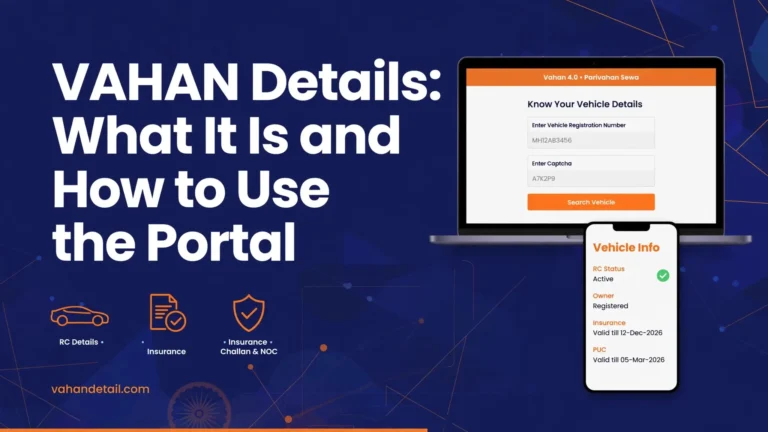
The VAHAN portal, run by the Ministry of Road Transport and Highways, keeps a central record that includes your vehicle’s insurance company, policy number and expiry date. Here is the process:
- Go to vahan.parivahan.gov.in and choose “Know Your Vehicle Details” under Online Services.
- Enter your mobile number and complete the OTP verification.
- Enter your vehicle registration number and the captcha, then click “Search Vehicle”.
- The result screen shows your insurance details alongside the registration record, including the insurer name, policy number and the policy expiry date.
This is the most official single source, because the data comes from the government’s own vehicle registry. If you are new to the portal, our Know Your Vehicle Details walkthrough explains every field on the result screen.
Method 2: Check on the IIB (Insurance Information Bureau) Portal
The Insurance Information Bureau of India, set up by IRDAI, maintains a national repository of motor insurance policies. Its V-Seva facility lets you verify policy status directly against insurer-reported data:
- Go to iib.gov.in and look under Quick Links for the vehicle insurance status option (V-Seva).
- Fill in the requested details: owner name, address, mobile number, email address and the vehicle registration number.
- Submit the form. The portal returns the available policy details, including insurer name, policy status and validity period.
One caveat: IIB data can lag behind real-time by up to a couple of months, because insurers upload their data in batches. So if you renewed your policy last week and the IIB still shows the old expiry, check the VAHAN portal or your insurer’s own site instead of panicking.
Method 3: Check on Your Insurer’s Website or App
If you know which company insures your vehicle, its own website or app gives the most detailed and current picture:
- Open your insurer’s official website or mobile app.
- Go to the policy section, renewals tab or quick-assist option.
- Enter your vehicle registration number, policy number or registered mobile number.
- View the full policy: status, expiry date, IDV (insured declared value), coverage type and add-ons.
This method is also the one to use when you need a digital copy of the policy during travel or at a checkpoint. Most insurers let you download the e-policy as a PDF in seconds.
Method 4: Use the mParivahan App
The mParivahan app, built by NIC for the Ministry of Road Transport and Highways, shows your virtual RC along with insurance and PUC validity. Install it from the Play Store or App Store, register with your mobile number, add your vehicle, and the document dashboard displays the insurance validity date. It is handy because the virtual RC plus insurance status live in one place on your phone.
How to Read Your Insurance Check Result
Whatever method you use, focus on these five fields.
| Field | What it tells you |
|---|---|
| Insurer name | Which company holds your policy |
| Policy number | Your unique policy identifier, needed for claims and renewals |
| Policy start and expiry dates | Whether you are currently covered |
| Coverage type | Third-party only, or comprehensive (own-damage plus third-party) |
| NCB / add-ons | No Claim Bonus status and extras like zero-depreciation cover |
If the portal shows no insurance record at all, either the policy data has not been uploaded yet (common right after a renewal) or the vehicle genuinely has no active policy. Wait a few days after renewal and recheck; if it still shows nothing, contact your insurer.
Third-Party vs Comprehensive: Which Do You Have?
The Motor Vehicles Act makes third-party liability cover mandatory, but that is the minimum. Third-party insurance covers injury or damage you cause to other people and their property. It does not pay for damage to your own vehicle. It is the cheapest option and the legal minimum. Comprehensive insurance adds own-damage cover for your vehicle (accidents, theft, fire, natural calamities) on top of third-party liability. It costs more but is the sensible choice for any vehicle worth protecting. Add-ons like zero-depreciation, engine protection and roadside assistance sit on top of a comprehensive policy and are worth considering for new or expensive vehicles. When you run your insurance check, confirm not just that a policy is active, but that the coverage type matches what you paid for.
When to Renew (and Why Timing Matters)
Renew before the expiry date, not after. A lapse of even one day creates problems: Inspection requirement: most insurers require a physical vehicle inspection before issuing a fresh policy after a break in coverage, which delays everything by days. No Claim Bonus at risk: your NCB discount is generally protected if you renew within 90 days of expiry, but beyond that window it lapses and your premium jumps. Zero coverage during the gap: any accident in the uninsured period is entirely on you, with no claim possible. Set a calendar reminder two weeks before expiry.
Claim Readiness Checklist
An insurance check is also a good moment to make sure you could actually file a claim smoothly:
- Save a PDF of your current policy on your phone and in your email.
- Confirm the registration number, engine number and chassis number on the policy match your RC. Mismatches can delay or sink a claim.
- Note your insurer’s claim helpline number in your phone contacts.
- After any accident, inform the insurer within 24 hours, take photos of the damage and the spot, and file an FIR if there are injuries or a third party is involved.
Insurance Check vs the Insurance Tool Page
If you arrived here from our vehicle insurance check tool page, think of that page as the quick lookup and this guide as the full manual: the page tells you the status, while this article explains every method, what the result means, and what to do next. For bike owners specifically, the same methods apply, and you can cross-check the registration side anytime with our RC status check guide.
FAQ
Is it free to check vehicle insurance status online?
Yes. The VAHAN portal, the IIB V-Seva facility and the mParivahan app are all free. Insurer websites and apps are free for their own policyholders.
Can I check someone else’s vehicle insurance by registration number?
The VAHAN portal shows basic insurance validity for any registration number after OTP verification with your own mobile number. Detailed policy documents are only available to the policyholder through the insurer.
My policy shows as expired on VAHAN but I just renewed. What should I do?
Wait a few days for the insurer’s data to sync, then recheck. If it still shows expired after a week, contact your insurer with the payment receipt and policy number and ask them to update the central records.
What is the fine for driving without insurance in India?
Under Section 196 of the Motor Vehicles Act, driving without valid third-party insurance attracts a fine of Rs 2,000 for the first offence and Rs 4,000 for subsequent offences, along with possible imprisonment.
Does a comprehensive policy automatically renew?
No. Motor policies do not auto-renew unless you have opted into an auto-debit arrangement with your insurer. Always confirm the renewal yourself before expiry.
Can I transfer my No Claim Bonus to a new vehicle?
Yes. NCB belongs to you, not the vehicle. When you sell a car and buy a new one, you can carry the NCB to the new policy with an NCB reservation letter from your old insurer.
Check your vehicle insurance policy status and validity online in four steps.
Open the VAHAN portal
Open the VAHAN portal and choose Know Your Vehicle Details, verifying your mobile number with OTP.
Enter your registration number
Enter your registration number and captcha to view insurer name, policy number and expiry.
Cross-check on IIB or your insurer
Cross-check on the IIB V-Seva portal or your insurer’s website if data looks stale.
Renew before expiry
Renew before expiry to protect your No Claim Bonus and avoid inspection delays.