
Learning Licence Test Questions and Answers: 2026 Mock Test Guide
If you are searching for learning licence test questions and answers, here is the short version. Most states run a 15-question multiple-choice test on the Sarathi portal, and you generally need about 60 percent correct answers to pass. This guide covers the test format, question categories, representative practice questions with answers, common failure mistakes, and what happens if you fail or pass.
The Real Learning Licence Test Format
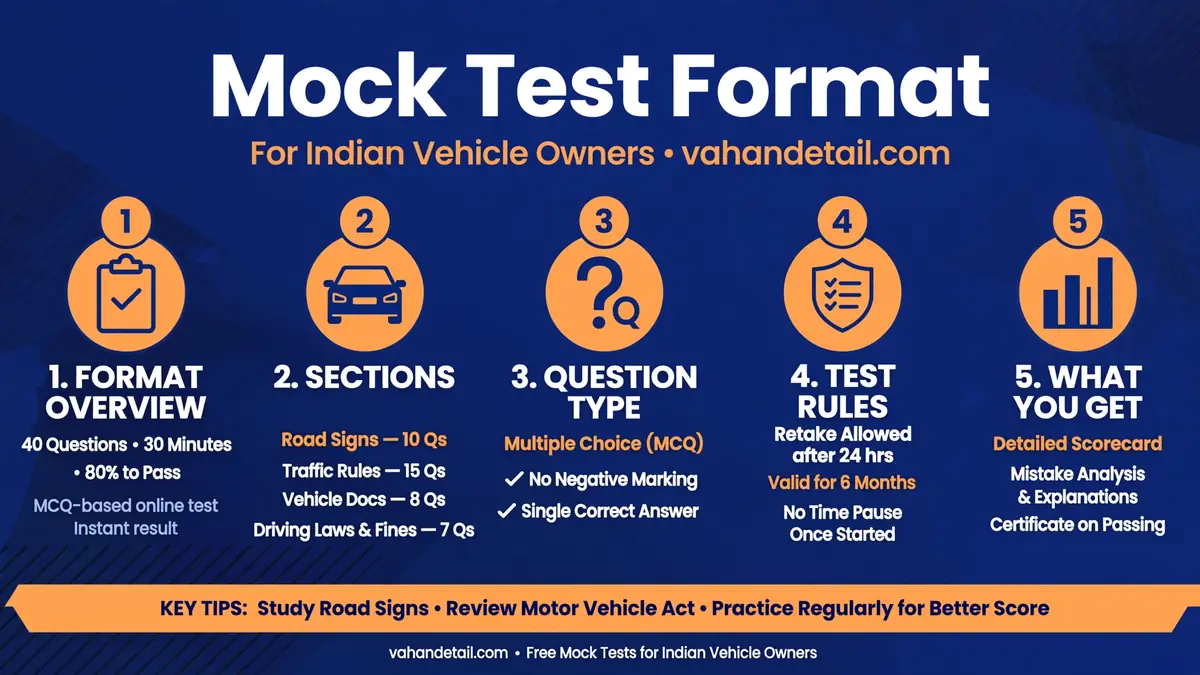
The test is a computer-based MCQ exam run through the Sarathi portal (sarathi.parivahan.gov.in) or at an RTO computer terminal. Here is the format in most states:
- Questions: 15 multiple-choice questions (a few states use 10 or 20, but 15 is the standard)
- Passing marks: about 60 percent, meaning 9 out of 15 in most states; a few states set a higher bar, so read the rule on your test screen before you begin
- Time limit: roughly 30 seconds per question, about 10 to 15 minutes total
- Languages: English, Hindi, and major regional languages; you pick your language at the start
- Result: shown instantly on screen
Many states let you take the test online from home with camera-based verification; some still require an RTO visit. If you are still at the application stage, our companion guide on applying for a learner’s licence online covers the form, documents, and fees step by step.
Learning Licence Test Questions and Answers by Category
Almost every question falls into one of five buckets. Studying these covers the whole syllabus.
Traffic signs is the biggest category. Learn the shapes first: red circles are mandatory signs (stop, no entry, speed limit), red-bordered triangles are warning signs (school ahead, sharp turn), and blue rectangles are informatory signs (hospital, fuel station). Knowing the shapes alone answers many of them.
Rules of the road covers right of way, overtaking, lane discipline, traffic lights, and pedestrian priority at zebra crossings.
Speed limits and safe driving covers speed limits in built-up areas and on highways, school zone caution, following distance, and headlight use at night.
Documents and penalties covers documents you must carry, fines for driving without a licence, and drunk driving limits under the Motor Vehicles Act.
Learner driver rules covers the “L” sign rule, supervised driving, and the licence validity period.
Practice: Learning Licence Test Questions and Answers with Explanations
Below are representative practice questions in the style of the real test.
Q1. What does a red-bordered triangular sign indicate?
A. It gives an order you must obey
B. It warns you of a hazard ahead
C. It gives information about facilities
D. It marks the end of a restriction
Answer: B. Triangles are warning signs, for example school ahead or men at work.
Q2. A red circle with a white horizontal bar means:
A. No entry
B. Stop
C. No overtaking
D. Hospital ahead
Answer: A. Circular signs are mandatory or prohibitory. The white bar on a red circle is the international no entry sign.
Q3. What should you do when approaching a zebra crossing where pedestrians are waiting?
A. Sound the horn and drive past
B. Slow down, stop before the crossing, and let pedestrians cross
C. Drive through without slowing
D. Overtake the vehicle ahead to cross first
Answer: B. Pedestrians have priority at zebra crossings; stop before the crossing line.
Q4. From which side should you normally overtake another vehicle in India?
A. From the left
B. From the right
C. From whichever side is free
D. Overtaking is never allowed
Answer: B. Overtake from the right after checking mirrors and signaling; overtaking from the left is illegal in normal conditions.
Q5. On a narrow hill road, which vehicle gets the right of way?
A. The vehicle coming down the hill
B. The vehicle going up the hill
C. The smaller vehicle
D. The faster vehicle
Answer: B. Uphill vehicles get priority because restarting uphill is harder.
Q6. What is the legal blood alcohol limit for driving in India?
A. 30 mg of alcohol per 100 ml of blood
B. 50 mg of alcohol per 100 ml of blood
C. 80 mg of alcohol per 100 ml of blood
D. There is no fixed limit
Answer: A. Section 185 of the Motor Vehicles Act sets the limit at 30 mg per 100 ml; a first offence can bring a fine of up to Rs. 10,000, imprisonment up to six months, or both.
Q7. What is the penalty for driving without a valid driving licence in India?
A. Rs. 500
B. Rs. 2,000
C. Rs. 5,000
D. A warning only
Answer: C. Driving without a licence now attracts a fine of up to Rs. 5,000.
Q8. How long is a learner’s licence valid, and when can you apply for a permanent licence?
A. Valid for 1 year, apply anytime
B. Valid for 6 months, apply for a permanent licence after 30 days
C. Valid for 2 years, apply after 6 months
D. Valid for 3 months, apply immediately
Answer: B. A learner’s licence is valid for 6 months, and you can take the permanent driving licence test only after holding it for at least 30 days.
Mistakes That Cause Most Failures
Most failures are about habits, not knowledge. Rushing is the top one: with about 30 seconds per question you have time to read properly, but many fail because they clicked too fast and misread the question. When unsure, eliminate the obviously wrong options first; on a 4-option MCQ, removing two wrong answers turns a guess into a 50-50 chance. Skipping the sign charts is another common mistake. Finally, take the free mock test on the Sarathi portal at least three times, including the “Sample Questions for LL Test” section, so the format and timer feel familiar.
What Happens If You Fail
Failing is common. In most states you can reappear after about 7 days, with a small re-test fee of around Rs. 50. Use the waiting week on the official mock test, especially the categories you got wrong, then book the re-test on the Sarathi portal.
What Happens After You Pass
Your result appears on screen immediately, and the learner’s licence is generated digitally soon after for download from the Sarathi portal. You may then drive on public roads, but only with the “L” sign displayed front and rear, only accompanied by a permanent licence holder, and only with the learner’s licence on you. You become eligible for the permanent driving licence test 30 days after the learner’s licence is issued.
After passing your test, you can check your driving licence application status online, and once the licence is issued you can check your driving licence details online to verify the licence number and status. Government processes and fees change from time to time, so for official forms and slot booking always cross-check the Parivahan Sewa portal before you act.
How many questions are asked in the learning licence test?
Most states ask 15 multiple-choice questions; a few use 10 or 20.
What are the passing marks for the learning licence test?
About 60 percent, which means 9 out of 15 in most states. Some states set the bar higher.
Can I take the learning licence test online from home?
In most states, yes, with camera-based identity verification. Some states still require an RTO visit.
In which languages is the LL test available?
English, Hindi, and major regional languages. You select your language at the start of the test.
What happens if I fail the learning licence test?
You can reappear after about 7 days in most states, paying a small re-test fee of around Rs. 50. Use the gap to practice on the official mock test on the Sarathi portal.