National Permit Apply Online: Eligibility, Fees and Documents (2026)
If you run a goods vehicle across state borders, the national permit is the single document that lets it operate throughout India without a separate permit from every state. Applying for a national permit online is done through the Parivahan portal’s VAHAN services and the home-state RTO, using Form 46 and Form 48, with a composite fee that covers all states in one payment. This guide covers who is eligible, the documents needed, the fee structure, and the exact application flow.
What Is a National Permit and Who Needs One?
A national permit, issued under Section 88 of the Motor Vehicles Act, 1988, authorises a goods carriage to operate across the whole of India. Without it, a truck registered in one state would need permits from every state it enters, which is impractical for interstate logistics.
You need a national permit if your vehicle carries goods for hire or reward across state lines. Local-only operators who stay within their home state can use a state goods permit instead, which costs less. The national permit is the companion article to our permit verification guide; if you already hold one and want to check its validity, read this: https://vahandetail.com/vehicle-permit-check-online/
Eligibility for a National Permit
The main eligibility conditions are straightforward but non-negotiable:
- The vehicle must be a goods carriage registered as a commercial vehicle with a valid Registration Certificate.
- The vehicle must hold a valid fitness certificate. The RTO will not process a national permit for a vehicle whose fitness has lapsed.
- The vehicle must have valid commercial insurance and a valid PUC certificate.
- Road tax for the vehicle must be paid up to date. Tax dues block the application.
- The vehicle must meet the age and condition norms the state applies to commercial vehicles. Very old or unfit vehicles are rejected at the inspection stage.
- The owner or operator must have valid KYC documents (Aadhaar, PAN, and for companies, the business registration documents).
For the registration side of these requirements, see our registration details guide: https://vahandetail.com/vehicle-registration-details-check-online/
Documents Required for National Permit Application
Keep these ready before you start, in scanned form for the online steps and in original for the RTO visit:
- Registration Certificate (RC) of the vehicle
- Valid fitness certificate
- Valid commercial vehicle insurance policy
- Valid PUC certificate
- Road tax payment receipts
- Owner’s Aadhaar and PAN (company documents for fleet owners)
- Chassis number pencil trace, if the RTO asks for it
- Demand drafts or online payment receipts for the applicable fees
National Permit Fees: The Composite Fee Explained
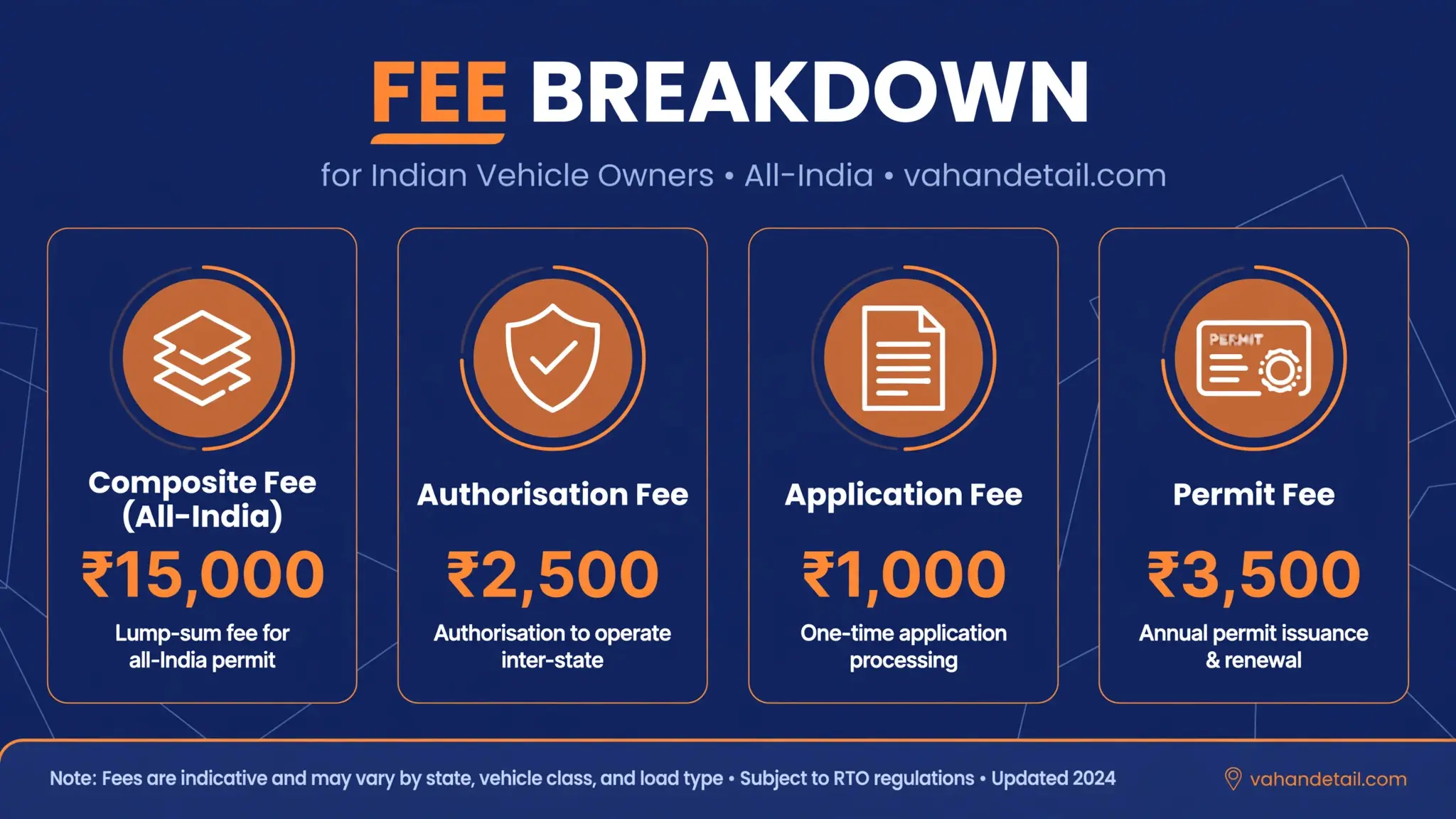
The fee structure has two parts, and the composite fee is the part that confuses most first-time applicants. Under the national permit scheme, you pay a single composite fee to your home state, which is then shared with the other states your vehicle will operate in. That is the whole point of the scheme: one payment instead of tax in every state.
| Fee component | Typical amount | Paid to |
|---|---|---|
| Composite fee (all-India) | Around Rs 16,500 per year | Home state, via the VAHAN portal |
| Authorisation fee | Around Rs 1,000 per year | Home state RTA |
| Application fee | Around Rs 50 | Home state RTA |
| Permit fee (5-year permit) | Around Rs 2,000 | Home state RTA |
The composite fee is paid for the one-year authorisation period and is renewed each year. Fee figures are revised periodically, so confirm the exact payable amount on the portal before paying; the structure above is how the components break down.
To complete the application online, you will use the national permit section of the VAHAN portal at https://vahan.parivahan.gov.in, which handles the composite fee payment and generates the government receipt you take to the RTO.
How to Apply for a National Permit Online: Step by Step
The application is a hybrid process: the fee payment happens online, while the forms and verification go through your home-state Regional Transport Authority.
Step 1: Prepare Form 46 and Form 48. The national permit application is filed in Form 46 with the authorisation details in Form 48. Fill in the vehicle details, the owner details, and the list of states the vehicle will operate in. The states listed must match the authorisation you are paying for.
Step 2: Submit to the home-state RTA and pay the authorisation fee. Submit the forms at the Regional Transport Authority of the state where the vehicle is registered, along with the documents listed above, and pay the authorisation fee at the counter.
Step 3: RTA uploads data to VAHAN. The transport authority verifies your documents and uploads the permit data to the national VAHAN permit portal. Transporters cannot upload this data themselves; only the authority can.
Step 4: Pay the composite fee online. Once the data is uploaded, pay the composite fee (around Rs 16,500 per year) through the VAHAN national permit payment section. Save the receipt with the Government Receipt Number immediately.
Step 5: Collect the permit. Return to the RTA with the payment receipt. The officer verifies the payment data and issues the national permit along with the Form 47 authorisation slip.
Step 6: Keep the Form 47 slip current. The national permit itself is valid for five years, but the Form 47 authorisation slip is valid for one year and must be renewed annually before it expires. This is the document check-post officers ask to see, and an expired slip is treated the same as no permit.
You can track any VAHAN application the same way you track RC applications: https://vahandetail.com/rc-status-check-online/
National Permit vs State Permit: Which One Do You Need?
| Factor | National permit | State goods permit |
|---|---|---|
| Operating area | All of India | Issuing state or region only |
| Cost | Higher (composite fee plus authorisation) | Lower |
| Best for | Interstate logistics, long-haul trucks | Local delivery, intra-state operations |
| Renewal cycle | 5-year permit, yearly Form 47 authorisation | Varies by state |
If your routes never cross a state border, the state permit is cheaper and simpler. The moment interstate movement is part of the business, the national permit pays for itself by removing the paperwork and delay at every border.
For a broader picture of every document a commercial vehicle carries, our vehicle information guide walks through the complete checklist: https://vahandetail.com/vehicle-information-online-guide/
How can I apply for a national permit online?
The application starts at your home-state RTA with Form 46 and Form 48 plus your vehicle documents and the authorisation fee. The RTA uploads your data to the VAHAN national permit portal, where you pay the composite fee (around Rs 16,500 per year) online at https://vahan.parivahan.gov.in, and the RTA then issues the permit with the Form 47 authorisation slip.
What is the composite fee for a national permit?
The composite fee is a single annual payment (around Rs 16,500) made to your home state that covers operations across all of India. The home state shares it with the other states, which is why you do not pay separate tax in each state you enter.
How long is a national permit valid?
The national permit itself is valid for five years. The Form 47 authorisation slip, however, must be renewed every year, and you cannot operate interstate with an expired slip.
What is Form 48 in a national permit application?
Form 48 carries the authorisation details of the national permit application, including the states the vehicle will operate in. It is submitted together with Form 46 at the home-state RTA.
Can I apply for a national permit completely online without visiting the RTO?
No. The composite fee payment is online, but the forms, document verification and permit issuance still go through your home-state Regional Transport Authority. Plan for at least one RTO visit.
What happens if I operate interstate without a national permit?
Operating a goods vehicle across state lines without a valid national permit is an offence under the Motor Vehicles Act. Check posts can detain the vehicle, and the fines are substantial, so the permit should be in place before the first interstate trip.
Apply for a national permit for your goods vehicle: prepare Form 46 and Form 48, submit at the home-state RTA, pay the composite fee online, and keep the Form 47 slip current.
Prepare Form 46 and Form 48
Fill in the vehicle details, owner details, and the list of states the vehicle will operate in.
Submit to the home-state RTA
Submit the forms with the documents and pay the authorisation fee at the counter.
RTA uploads data to VAHAN
The transport authority verifies your documents and uploads the permit data to the national VAHAN permit portal.
Pay the composite fee online
Pay the composite fee (around Rs 16,500 per year) through the VAHAN national permit payment section and save the receipt.
Collect the permit
Return to the RTA with the payment receipt; the officer issues the national permit with the Form 47 authorisation slip.
Keep the Form 47 slip current
The national permit is valid for five years, but the Form 47 authorisation slip must be renewed annually.