Vehicle Owner Details by Number Plate: What You Can Legally Find
Looking up vehicle owner details by number plate is legal when you use official channels, but the law draws a clear line between what is public and what is private. On the VAHAN portal you can see the registered owner’s name along with the vehicle’s registration record, while personal contact details like phone numbers and home addresses are not publicly exposed. This guide explains exactly which fields are public, which are protected, and the proper legal channels to use when you need more, whether you are buying a used car, dealing with a hit and run, or checking a suspicious vehicle.
What VAHAN Shows You Legally
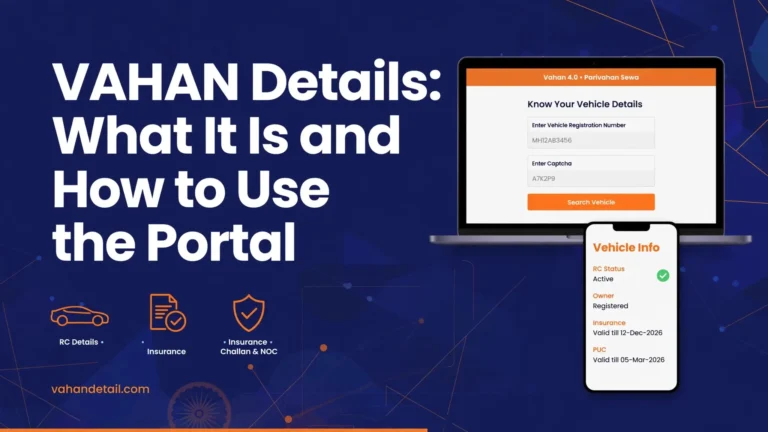
The national VAHAN database, maintained by the Ministry of Road Transport and Highways, powers the official vehicle lookup services. When you enter a registration number on vahan.parivahan.gov.in through the “Know Your Vehicle Details” service, the record you get back typically includes:
- Registration number and registration date
- Registered owner’s name
- Vehicle class, maker and model
- Chassis number and engine number
- Fuel type
- Insurance validity and insurer
- Fitness validity (for transport vehicles)
- Hypothecation details, if the vehicle is financed
- Pollution Under Control (PUC) validity
- Blacklist or permit status flags
This is the same official record the RTO itself works from, which is why it is the most trustworthy source. Our step by step owner details lookup guide walks through the portal process, and the VAHAN report guide explains how to read each section.
What You Cannot Get From a Public Lookup
There is a deliberate boundary in the system, and understanding it keeps you on the right side of the law:
- Mobile number: not exposed in public lookups.
- Full residential address: not exposed in public lookups.
- Aadhaar or ID numbers: never part of any public vehicle record.
- Driving licence details of the owner: separate system, separate access rules.
The logic is straightforward. The public record is designed to answer “what is this vehicle’s official standing” (registration, insurance, fitness, dues), not “where does this person live and how do I contact them”. If your need is legitimate but goes beyond the public fields, there are proper channels for that, covered below. Anything else, paid “full details” websites, agents offering phone numbers and addresses, data brokers on social media, is either a scam or an illegal data trade. Stay away from both.
Legitimate Reasons People Search Owner Details
Knowing which reason is yours matters, because it determines the right channel:
Buying a used vehicle. You want to confirm the seller is the registered owner, check for hypothecation (an unpaid loan the buyer could inherit), and verify insurance and challan standing. The public VAHAN record covers all of this, which is why due diligence guides like our vehicle legal report start there. If anything looks off, walk away before paying a token amount.
Accident or hit and run. You noted a number plate but nothing else. The public record gives you the registered owner’s name and the vehicle’s registration details, which is exactly what you hand to the police along with your complaint. The police have access to the full record and will contact the owner through official channels.
A vehicle parked suspiciously or blocking your property. The public record confirms the registration details. For action beyond that, such as getting it towed or identifying the owner, the traffic police or local police station is the right authority, not a private data agent.
Verifying a taxi, cab or commercial vehicle. Checking the registration, permit and fitness validity on VAHAN is a sensible safety step before a long trip, and all of it is public information.
Insurance or legal claims. Courts, insurers and lawyers access vehicle records through formal requisitions to the RTO. If you are party to a claim, your insurer or advocate handles this.
The Proper Legal Channels When the Portal Is Not Enough
When you need details the public portal does not show, use one of these, in order of how commonly they apply:
1. The police. For accidents, hit and run cases, stolen vehicles, fraud or harassment involving a vehicle, file a complaint or FIR at the nearest police station (or online where your state supports it). Give them the number plate and whatever you observed. The police can pull the complete registered owner record from VAHAN and will contact the owner. This is the correct route in every criminal or civil wrong scenario.
2. The RTO, with a written request. If you have a genuine reason connected to a vehicle, such as a civil dispute, an insurance matter or a pending sale, you can approach the registering RTO with a written application explaining the need. The RTO decides what to share based on the reason and the rules. Bring identity proof and any supporting documents that establish your connection to the matter.
3. The court. In litigation, vehicle owner details are obtained through court orders and formal discovery. Your advocate will know the procedure.
4. The insurer. In motor accident claims, the insurer investigates and obtains the relevant records through its own formal channels.
What you should never do: pay a random website or social media account for “complete owner details”, or use someone’s personal data from an unofficial source to contact or confront them. Beyond being unreliable (much of this data is stale or fabricated), misusing personal data can land you in legal trouble of your own.
How to Run a Legal Lookup: The Quick Process
For completeness, here is the legitimate process in brief:
Step 1: Go to vahan.parivahan.gov.in and open the “Know Your Vehicle Details” service.
Step 2: Create an account or log in, and verify with the OTP sent to your mobile number.
Step 3: Enter the full registration number in the correct format.
Step 4: Review the record: owner name, registration details, insurance, fitness, hypothecation and any flags. For the detailed walkthrough, see our complete owner details guide.
Step 5 (no smartphone or internet): Send an SMS in the format VAHAN <space> <vehicle registration number> to 07738299899. You get the basic vehicle details back by text.
If the portal shows no record or mismatched details, that itself is useful information: it can mean a fake plate, a very old record not yet digitised, or a data entry issue worth raising with the RTO.
Tracing an Unknown Vehicle: A Worked Example
Suppose a car hit your parked bike at night and drove off, and a neighbour noted the number plate. Here is what a legal, effective response looks like:
- Note the exact plate, time, place and any description of the vehicle.
- Look up the plate on VAHAN to confirm the registration details and the registered owner’s name, and take a screenshot.
- File a complaint at the nearest police station with these details. The police trace the owner through the official record and take it from there.
- Inform your insurer if there is damage to claim.
What you do not do: post the plate on social media asking strangers to “find this person”, or pay an online “vehicle tracing” service. Both create more problems than they solve.
Can I legally find vehicle owner details by number plate in India?
Yes. Looking up a vehicle’s official registration record on the VAHAN portal is legal. The registered owner’s name and the vehicle’s registration, insurance and fitness details are public information. Personal contact details are not publicly exposed.
What owner details does VAHAN show publicly?
The record shows the registered owner’s name, registration number and date, vehicle class, maker and model, chassis and engine numbers, fuel type, insurance validity, fitness validity, hypothecation status and blacklist flags.
Can I get the owner’s phone number or address from the number plate?
No, not through any public or legal self service channel. Mobile numbers and home addresses are not part of the public vehicle record. For legitimate needs such as an accident case, the police or the RTO can access the full record.
I am buying a used car. What should I verify from the number plate?
Confirm the seller matches the registered owner name, check for hypothecation (financer’s name means a loan is active), verify insurance and PUC validity, check pending challans, and look for blacklist flags. See our used car RC check guide for the full checklist.
What should I do after a hit and run if I only have the number plate?
Look up the plate on VAHAN to confirm the registration details, then file a police complaint with the number, time and place. The police will trace the registered owner through the official record.
Are websites selling “complete vehicle owner details” legal?
No. Sites and agents selling phone numbers, addresses or other personal data harvested from vehicle records are operating outside the law, and much of their data is stale or fake. Use only the official VAHAN portal, the police, or the RTO.
Follow these four steps to find vehicle owner details by number plate through official channels.
Open the VAHAN portal
Use the Know Your Vehicle Details service on vahan.parivahan.gov.in.
Enter the registration number
Log in, verify with OTP and enter the full number plate.
Review the public record
Check owner name, registration, insurance, fitness and hypothecation details.
Use proper channels for more
File a police complaint for accidents or apply to the RTO in writing for other legitimate needs.