Vehicle Insurance Renewal Online: Steps, Documents and Mistakes to Avoid (2026)
Renewing your policy does not have to be stressful, and vehicle insurance renewal online is usually the quickest way to do it. You can compare plans, check your No Claim Bonus, choose useful add-ons, pay securely, and download your new policy document in a single sitting, often within minutes. The key is to start early, keep your documents ready, and read the details carefully before you pay.
Most owners only think about insurance when the expiry date is close. That last minute rush is exactly when mistakes happen, such as choosing the wrong cover, entering the wrong IDV, or missing a discount you had earned. This guide walks you through the full renewal process, from comparing plans to avoiding the errors that cost money later.
Why Renew Before Expiry
In India, third-party cover is mandatory under the Motor Vehicles Act, so driving without valid insurance is not just risky, it is also against the law. Comprehensive cover, which also protects your own vehicle against damage, theft, and other listed events, is optional, but many owners choose it for the extra protection.
Renewing before the expiry date matters for three simple reasons. First, you avoid any gap in cover, so you are never unprotected on the road. Second, you avoid legal trouble and possible fines for driving uninsured. Third, renewal is usually smoother before expiry, because a lapsed policy can trigger extra steps, such as an inspection, before the insurer agrees to renew it.
A good habit is to set a reminder at least two weeks before expiry. That gives you time to compare options calmly instead of rushing into the first quote you see.
Check Your Current Policy First
Before you start comparing new plans, take five minutes to understand what you already have. Open your current policy document and note the following details:
- The exact expiry date and time
- Whether the policy is third-party only or comprehensive
- The current Insured Declared Value, usually called IDV
- The add-ons included in the current policy
- Your No Claim Bonus percentage, if any
- Any claims made during the current policy year
This information helps you compare like with like. If a new quote looks much cheaper, check whether it has a lower IDV, fewer add-ons, or a higher voluntary deductible. A cheaper premium is not always a better deal.
It is also worth confirming your vehicle details before renewal. Checking your registration details on the Vahan portal can help you spot an error in the chassis number, fuel type, or registration details before that error carries over into a new policy. The Parivahan portal is the official gateway for vehicle related services, and it is a useful starting point if you need to verify basic vehicle information.
If you are unsure whether your current cover is still active, our guide on how to check vehicle insurance online explains the steps in detail.
Understand No Claim Bonus and NCB Protection
No Claim Bonus (NCB) is a discount insurers offer for every claim-free year. It rewards careful driving, and it can make a real difference to your renewal premium. In general, NCB can go up to 50% after five claim-free years, following the standard industry slab, although the exact percentage depends on your insurer and your claim history.
Here is how NCB usually builds up:
- First claim-free year: a small discount begins
- Second claim-free year: the discount increases
- Third and fourth claim-free years: the discount keeps growing
- Fifth consecutive claim-free year: the discount can generally reach up to 50%
One important point is that NCB belongs to you, the policyholder, not to the vehicle. If you sell your old vehicle and buy a new one, you can usually transfer your NCB to the new policy with an NCB certificate from your previous insurer. Do not let that discount slip away during a vehicle change.
NCB protection is a separate add-on worth considering. Without it, even one claim can reduce your NCB sharply at the next renewal. With NCB protection, you may be allowed a limited number of claims without losing the full bonus, subject to the insurer’s terms. Read the conditions carefully, because the number of allowed claims and other limits vary by insurer.
If you have made a claim this year, be honest about it during renewal. Hiding claim history can create serious problems later, especially if you need to make a claim under the new policy.
Compare Plans Before You Renew
Many owners simply renew with the same insurer without checking alternatives. That is convenient, but it is not always the best value. A short comparison can reveal a better IDV, a useful add-on, or a lower premium for similar cover.
When you compare plans, look beyond the premium and check these points:
- IDV offered, because this is broadly the maximum amount payable in case of total loss or theft
- Third-party cover and own damage cover included
- Add-ons available and their cost
- Network garages for cashless claims in your city
- Claim settlement process and reputation of the insurer
- Voluntary deductible, which is the amount you agree to pay from your pocket during a claim
- Exclusions, meaning situations the policy does not cover
Do not choose the lowest IDV just to lower the premium. A low IDV saves a little money now, but it can leave you underinsured when you need the cover most. On the other hand, setting an IDV far above the vehicle’s realistic value does not help either, because insurers settle based on the IDV and the policy terms, not on an inflated figure.
Take quotes from two or three insurers, compare the same IDV and add-ons, and then decide. If two plans look similar, the one with better garage coverage and a clearer claim process is often the wiser choice.
Add-Ons Worth Considering
Add-ons increase the premium, but the right ones can save you a large expense later. You do not need every add-on, so choose based on your vehicle, your city, and how you use the vehicle.
| Add-on | What it generally covers | Worth considering if |
|---|---|---|
| Zero depreciation cover | Full cost of replaced parts without depreciation deduction | Your vehicle is relatively new. |
| Roadside assistance | Towing, jump start, fuel delivery, and minor on-road help | You travel long distances often. |
| Engine protection | Damage to the engine from water ingress or oil leakage in covered events | You drive in flood prone areas. |
| Return to invoice | Difference between IDV and the original invoice price in case of total loss or theft | Your vehicle is new and financed. |
| NCB protection | Helps protect your No Claim Bonus after a limited number of claims | You have built up a high NCB. |
| Consumables cover | Cost of nuts, bolts, oil, and similar consumables during repairs | You want fewer out of pocket repair costs. |
Zero depreciation cover is especially popular for newer vehicles, because standard policies deduct depreciation on parts such as plastic, rubber, and metal. For older vehicles, the benefit may be smaller, so weigh the extra premium against the likely repair savings.
Read the wording of each add-on before adding it. Some add-ons apply only in specific situations, and some have limits on the number of claims. A useful add-on is one you understand, not just one that sounds attractive.
Documents Needed for Vehicle Insurance Renewal Online
Online renewal usually needs fewer documents than people expect, because insurers can often fetch your previous policy details automatically. Still, keep the following ready so the process does not stall halfway:
- Previous policy number and expiry date
- Vehicle registration number
- Registration certificate details, such as chassis number and engine number
- Your driving licence details, if asked
- Aadhaar or other identity proof, if the insurer requests KYC
- Address proof, if your address has changed
- Previous claim details, if any
- NCB certificate, if you are transferring NCB from another insurer or vehicle
- Inspection report, if your policy has lapsed and the insurer asks for one
If your address, mobile number, or email has changed, update it during renewal. Your policy document, renewal reminders, and claim updates all depend on correct contact details. A wrong email address is a small error that can cause a big delay when you need help.
For two wheeler owners, the same renewal logic applies. If you ride a bike, our guide on bike insurance check online can help you verify your existing bike policy details before renewal.
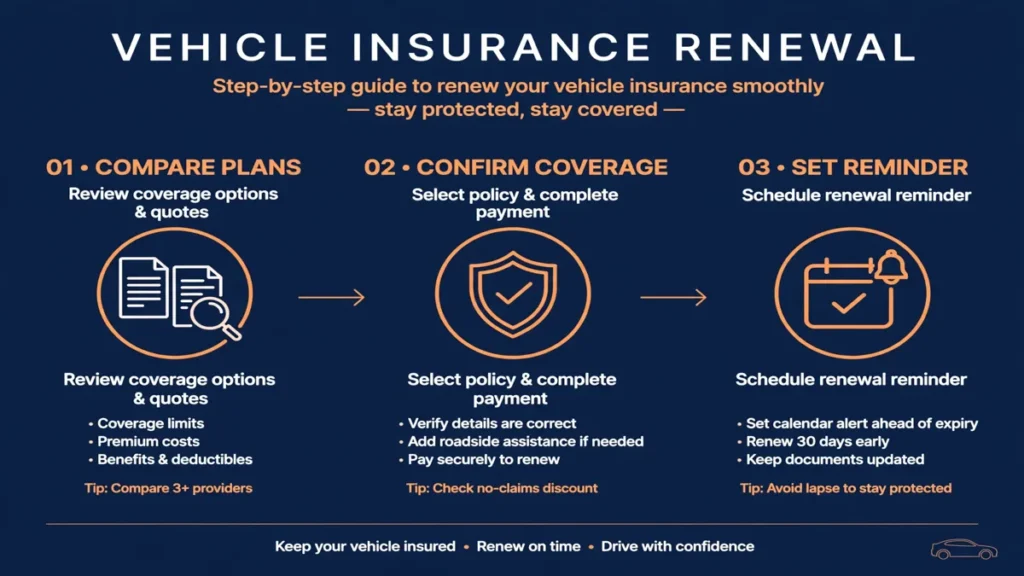
Vehicle Insurance Renewal Online: Step-by-Step Process
Follow these steps for a smooth vehicle insurance renewal online experience:
- Visit your insurer’s website or app, or an insurance comparison platform you trust.
- Select renewal, then enter your vehicle registration number and previous policy details.
- Confirm the vehicle details shown, including make, model, fuel type, and registration year.
- Check your current IDV and adjust it sensibly if the suggested value looks too low or too high.
- Review your No Claim Bonus and confirm it matches your claim-free record.
- Choose between third-party only and comprehensive cover, based on your needs.
- Select add-ons that suit your vehicle and usage, and remove any you do not need.
- Review the premium breakup, including own damage premium, third-party premium, GST, and add-on costs.
- Enter your personal and contact details carefully, and double check your mobile number and email.
- Make the payment through a secure payment page, using UPI, net banking, card, or another offered method.
- Download the new policy document immediately, and save a copy on your phone and email.
- Check the new policy for errors in your name, vehicle number, IDV, cover type, and dates.
Do not close the payment page until you see a clear success message. If the payment is deducted but the policy is not issued, note the transaction reference and contact the insurer promptly. In most cases the issue is resolved once the payment is matched, but keeping the reference number makes follow up much easier.
After renewal, keep both the old and new policy documents for a while. The old policy is useful for NCB proof and claim history, and the new policy is the document you will need on the road.
What Happens If Your Policy Has Lapsed
A lapsed policy means your cover has already expired. You can still renew, but the process may be different. A vehicle inspection may be required before the insurer issues a new comprehensive policy, because the insurer wants to confirm the vehicle’s current condition. This is normal, and it should not worry you, but it does add time to the process.
Other consequences of a lapse include:
- No cover during the lapsed period, so any accident or damage in that period is not covered
- Possible loss of NCB if the gap goes beyond the allowed grace period under the insurer’s terms
- Extra paperwork or inspection charges in some cases
- Legal risk if you drive while uninsured
If your policy has lapsed, do not drive the vehicle until the new policy is active. Renew as soon as possible, complete any inspection the insurer asks for, and confirm the start date of the new policy before taking the vehicle out.
If you later need to track a claim under a renewed policy, our guide on vehicle insurance claim status online explains how to follow the claim from filing to settlement.
Common Renewal Mistakes to Avoid
Letting the policy lapse
The most expensive mistake is also the simplest to avoid. A coverage gap leaves you unprotected and can cost you your NCB. Set reminders, enable auto reminders from your insurer, and renew a few days early.
Choosing the wrong IDV
Insured Declared Value (IDV) is the backbone of a comprehensive policy. Too low, and you are underinsured. Too high, and you pay extra premium without matching benefit. Choose an IDV close to the vehicle’s current market value, as suggested by the insurer’s range.
Hiding claims history
You should never hide a previous claim to protect your NCB. Insurers share claim records, and a mismatch can lead to rejection of a future claim or cancellation of the policy. Honesty protects you far more than a short term discount.
Ignoring exclusions
Every policy has exclusions, and you should read the exclusions before you pay. Common exclusions include driving without a valid licence, driving under the influence of alcohol, using a private vehicle for commercial purposes without the right cover, and damage from wear and tear. Knowing these limits in advance prevents unpleasant surprises during a claim.
Renewing without comparing
Loyalty is good, but blind renewal can cost money. Even a ten minute comparison each year can reveal a better IDV, a useful add-on, or a lower premium for the same cover.
Entering wrong details
A spelling error in your name, a wrong registration number, or an outdated address can delay claims and create trouble during verification. Check every field before payment, because correcting a policy later takes time.
Forgetting to save the policy
After payment, download and save the new policy right away. Keep a digital copy on your phone, a copy in your email, and a printout in the vehicle if you prefer a physical copy. During a traffic check or an emergency, quick access to your policy document matters.
Tips to Keep Renewal Simple Every Year
- Renew at least a week before expiry, not on the last day
- Keep your previous policy number saved in your phone
- Drive claim free where possible, and protect your NCB
- Review add-ons each year instead of copying last year’s choices blindly
- Update your contact details whenever they change
- Save the insurer’s claim helpline number with your policy document
- Review your IDV as your vehicle ages, rather than keeping the same figure every year
Small habits like these turn renewal from a stressful last minute task into a quick annual routine.
Frequently Asked Questions
Can I renew vehicle insurance online after it has expired?
Yes, in most cases you can renew after expiry, but the insurer may ask for a vehicle inspection before issuing a comprehensive policy, and you will have no cover until the new policy starts. Renew as soon as possible and avoid driving until the new policy is active.
How early should I renew my vehicle insurance?
You can usually renew shortly before the expiry date, and starting one or two weeks early is ideal. Early renewal avoids a coverage gap, gives you time to compare plans, and leaves room to complete an inspection if one is needed.
Does my No Claim Bonus transfer if I change insurers?
Yes, NCB generally belongs to you and can be transferred when you switch insurers or vehicles, usually with an NCB certificate from your previous insurer. Confirm the NCB percentage during renewal so the discount is applied correctly.
Is third-party insurance enough, or should I choose comprehensive cover?
Third-party cover is mandatory and covers liability towards others, but it does not cover damage to your own vehicle. Comprehensive cover adds own damage protection and optional add-ons, so it is usually the better choice for newer or financed vehicles.
What documents do I need for online renewal?
You mainly need your previous policy details, vehicle registration number, and registration certificate details. Keep identity proof and NCB related documents ready if the insurer asks for them, and have inspection documents ready if your policy has lapsed.
What should I check immediately after renewing online?
Check your name, vehicle number, cover type, IDV, NCB, add-ons, and the policy start and end dates on the new document. If you spot any error, contact the insurer at once and get a corrected policy before you rely on it.
Check your current policy
Note the expiry date, cover type, IDV, add-ons and No Claim Bonus on your current policy.
Compare plans
Compare IDV, cover, add-ons, network garages and claim process from two or three insurers.
Enter vehicle and policy details
Select renewal and enter your vehicle registration number and previous policy details.
Choose cover and add-ons
Choose third-party only or comprehensive cover and select add-ons that suit your vehicle.
Review the premium and pay
Review the premium breakup, check your contact details, and pay through the secure payment page.
Download and check the new policy
Download the new policy immediately, save copies, and check name, vehicle number, IDV, cover and dates.